


The company
Why Tacel
A Canadian traffic technology company, since 1979.
We supply, configure and support the equipment that runs Canadian intersections: signals, cabinets, controllers, detection and accessible pedestrian crossings. And the people who pick up the phone when something is wrong.
Traffic is the only line of work we are in, and most people meet it without ever noticing. A push button that answers when it is pressed. A left turn that arrives when it should. A signal that keeps its timing through a power cut, a snowstorm, a summer of forty-degree afternoons. When it is done well nobody thinks about it at all, which is exactly why it is worth doing well.
What we are trying to be is the company an agency can still call in year eight. Anyone can win a bid. The harder thing is being the one who still knows the equipment once the person who installed it has moved on and the drawing is out of date. We would rather add a product slowly and stand behind it for a decade than carry a catalogue we cannot answer for.
- 1979
- On Canadian roads since
- 4
- Canadian offices, coast to coast
- 15
- Manufacturing partners represented
- ISO 9001
- Certified quality management, 2015 standard
What we supply
Everything that lives in an intersection or around it, short of the concrete. We hold every category in stock, configure it before it ships, and support it afterwards.
Holding it in stock is the easy half. What takes years is knowing which combination survives a particular corner: which detector to trust where the sun sits low across the approach, which cabinet layout a crew can work in with gloves on, which controller a municipality already owns fifty of and why it does not want fifty different ones.
- Traffic signal controllersATC, NEMA and 170/2070 controllers, plus the modules that go in them.
- Traffic cabinetsBase-mount and pole-mount cabinets, wired and tested before they ship.
- Conflict monitorsThe unit whose only job is to catch the failure nobody planned for.
- Vehicle and pedestrian detectionRadar, thermal, in-ground and AI-assisted analytics.
- Pedestrian safetyAccessible signals, push buttons and rectangular rapid flashing beacons.
- Signals and LED modulesThe heads and modules the road user actually looks at.
- CommunicationsWired and wireless networks connecting intersections to each other.
- Traffic management softwareCentral systems and analytics that turn field data into decisions.
- Battery backup powerKeeping an intersection lit through an outage.
What's inside the cabinet
Traffic infrastructure runs outdoors, all year, through Canadian winters and humid summers. When it fails it tends to fail completely, and until then nobody looks at it very closely. We build for that.
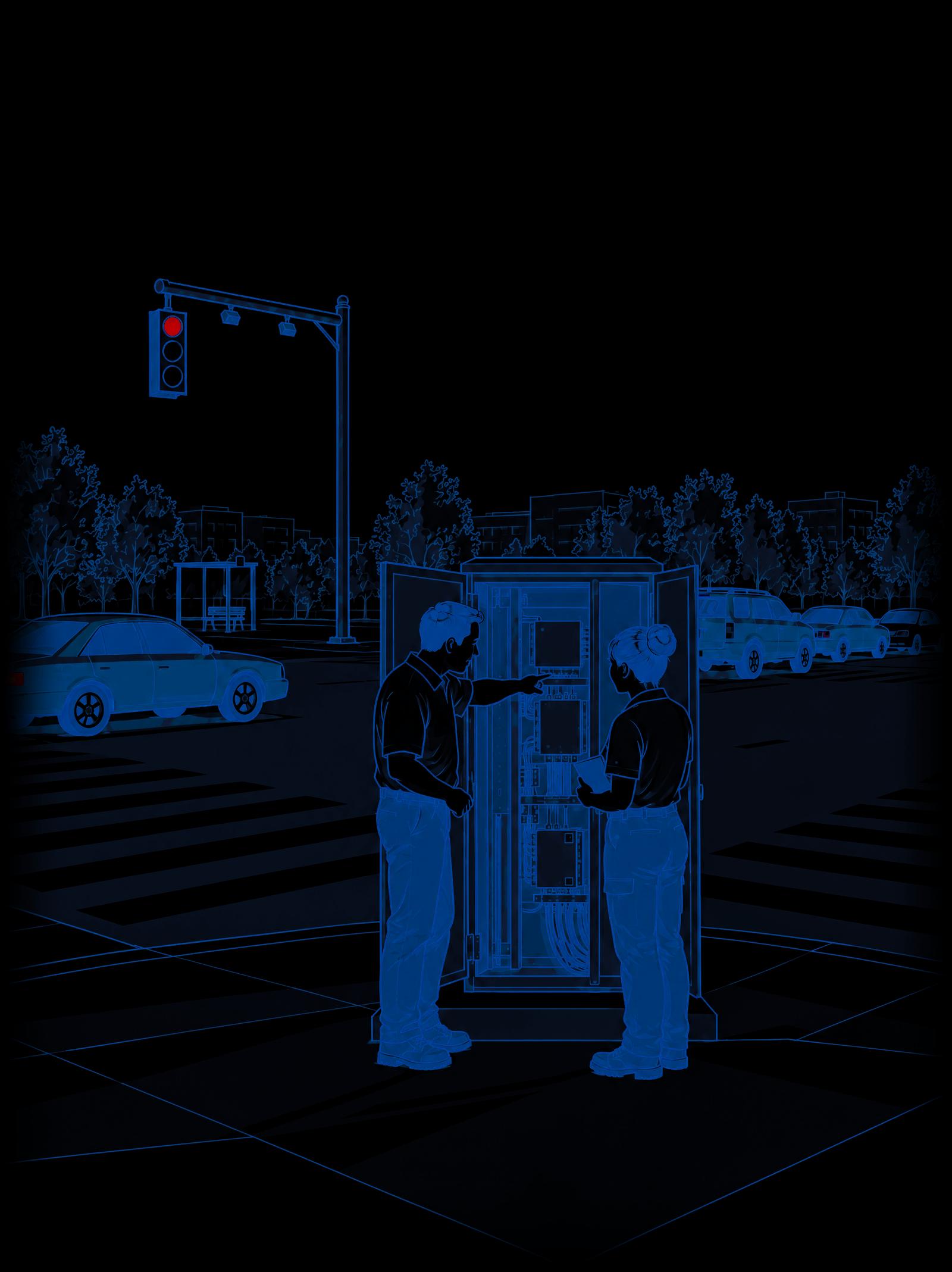
What we look at: component selection and how the wiring is organized. Runs that are labelled and dressed so a technician can follow them at midnight in the rain. Terminal blocks reachable without dismantling half the cabinet. Testing before it ships, and documentation that travels with the unit.
On commissioning day none of it is visible. It becomes visible at the first fault eight years later, when somebody is diagnosing the unit at the roadside in traffic.
It is also why consistency matters as much as the quality of any single cabinet. A municipality taking twenty cabinets over five years should be able to open any one of them and find the same layout. That is what makes maintenance predictable, and what lets a crew be trained once rather than with every delivery.
We build to the standard the customer already runs: NEMA TS1 and TS2, ATC and ATCC, the MTQ PT2P standard, Ontario Book 15, and Quebec's Tome V and Tome VII. Our own designs are kept as master specifications rather than rebuilt from memory each time, which is what lets the twentieth cabinet match the first.
What an intersection can see
Modern traffic infrastructure reaches well past signal control. What is changing fastest is what an intersection can perceive.
Vehicle and pedestrian detection now spans radar, thermal imaging and AI-assisted analytics that can tell a car from a cyclist from a person waiting at the corner. Accessible pedestrian signals add audible and tactile cues. Communications networks connect intersections to each other, and traffic management software turns what they see into something an operator can act on.
The list matters less than what it lets an agency do. Better detection cuts the service calls that failed loops generate. Emergency vehicle preemption and transit signal priority clear a corridor when it counts. And once the data is good enough, decisions can come from measurements instead of complaints.
The accessible side of that matters more than the technology usually gets credit for. A button that announces which street is crossing, a tone that locates the far corner, an arrow vibrating under the hand: for somebody who cannot see the walk symbol, that is the difference between crossing and waiting for help. We spend time with the people who rely on it, at gatherings like CNIB's Connecting the Dots, because a specification will not tell you whether a crossing actually works.
Who answers the phone
You can specify equipment on paper. Somebody still has to configure it, pick up when an intersection starts behaving strangely, train the crew who will run it, and handle the unit when it comes back under warranty.
Our traffic engineers and field technicians program controller databases, audit signal performance, time whole corridors and assemble custom cabinets. The same people support that equipment once it is in the ground.
It is a small company on purpose. There is no first tier to get past, no ticket that has to age before somebody senior looks at it, and the person who answers has usually seen your intersection before. When they have not, the person who has is down the hall.
Training is part of the same job. We run hands-on sessions at your yard or ours on controllers, conflict monitors, detection and accessible pedestrian signals, taught by the technicians who support that equipment, in English or in French.
After the delivery
A signal installed today will still be running in ten years, and somebody has to support it for all of them. So the delivery is closer to the beginning of the job than the end of it.
In practice that means organized stock, people who know the product on the phone, technical troubleshooting that goes further than pointing at the manual, warranty coordination with the manufacturer, and a repair bench where every returned unit is evaluated and quoted before any work starts.
That continuity has a practical reason. The person who configured a controller recognises how it behaves years later, and the team who prepared a cabinet knows what is inside it when the call comes in. That is hard to reproduce when every stage is handed to a different company.
We also keep the records a ten-year-old intersection depends on: every controller database in our library, drawings that match each cabinet, and older manual revisions alongside the current ones, because the newest document on a manufacturer's website is often not the one that describes the unit in your cabinet.
How a technology gets here
We represent fifteen manufacturers, among them Polara, Teledyne FLIR, Sensys Networks, EDI, Q-Free, Derq, Carmanah, TraffiCalm and Applied Information. Our part is choosing the technologies that solve an actual transportation problem here, then adding the local knowledge, configuration, training and service that make one work on a Canadian road.
We add a technology to the catalogue once we are confident we can support it, which is usually a while after it first turns up.
Representing a manufacturer starts with being trained on it. Before a product reaches a customer our own people sit through the same sessions we later run for agencies and contractors: Polara and EDI in Laval and Quebec City, MaxTime alongside Primary Engineering. We keep running them, because equipment nobody has been taught to use is equipment that gets replaced instead of adjusted.
Where you'll run into us
Every year we are out on the Canadian transportation conference circuit, coast to coast: on the exhibit floor in Burlington, at the congress in Quebec City, in the technical sessions in Coquitlam.
This is not attendance for its own sake. It is where we hear what is failing in the field before a purchase order writes it down, and where an engineer can open a cabinet, hold a push button and ask a hard question face to face.
We turn up for the parts that are not the exhibit floor as well: the golf tournament at the IMSA AGM, the hockey tournament in Quebec. Written on a company page it sounds like nothing. It is also how you come to know, by name, the person who rings at seven in the morning about an intersection flashing red.
When nothing is being sold
Road safety is not only a product category to us. The simplest way to show that is to say where we go when there is no purchase order at the end of it.
Teaching kids to read a road
We run the traffic safety side of the Bikes4Kids bike rodeo in Toronto, alongside the Toronto Police Service Community Partnerships unit and the charity New Kindness. Children learn to read a signal and ride safely on a closed track.
Sitting in the accessibility room
We attend CNIB Connecting the Dots with Polara, because accessible pedestrian signals are specified by engineers and used by people who are blind or have low vision, and those two rooms do not meet often enough.
The clearest example is a bike rodeo. In June we spent a Saturday at Esther Shiner Stadium with the Toronto Police Service and New Kindness: a course for the kids, helmets fitted properly, shoulder checks and stop lines taught to riders who are years away from a driver's licence.
No order comes at the end of a day like that, and it is closer to the actual job than a good deal of what we sell. Every device in the catalogue exists because somebody has to cross a road. Spending a morning with the eight-year-olds who will be crossing it for the next seventy years is not charity. It is the same work, done further upstream.
Staying consistent
Tacel runs an ISO 9001:2015 certified quality management system. In practice that means documented processes rather than habits, checks during assembly and not only at the end, testing before shipment, and a formal route by which something found in the field comes back and changes how the work is done.
The certificate on its own proves very little. What it buys is discipline: the same steps in the same order, whoever happens to be doing the work that week.
It shows up in ordinary places. A cabinet leaves with the drawings that match it. A repair comes back with a record of what was done to it. A configuration is written down somewhere other than in the head of whoever loaded it. None of that is exciting, and all of it is why the twentieth unit of a program behaves like the first.
For an agency the result shows up in the field: fewer surprises at commissioning, faster diagnosis when a cabinet is opened years later, and replacement units that drop into place because they were built to the same specification as the ones around them.
Where we are
Four Canadian offices, each stocking the full catalogue and covering its region with people who know it.
The reason to have them is not coverage on a map. It is that the person who takes the call has stood at intersections in that province, knows which controller the local agencies standardized on years ago, and can be at the cabinet the same week rather than the following month. Stock sitting two provinces away is stock you are still waiting for.
Regions genuinely differ. What a municipality in Quebec specifies is not what one in British Columbia specifies: the winter loads, the standards, the approval process and the language of the drawings all change as you cross the country. One national desk would learn all of that badly. Four teams learn their own part of it properly.
So there is no central queue to be routed through. You get the office that covers you, and the same people every time.
Recently
What the work amounts to, in the words of the projects themselves.
Read them for the pattern rather than the individual job. The same names come back, years apart, on different corners of the same city. In this line of work that is the only review worth anything: somebody who has already seen how we finish, choosing to start again.
Company News
Welcome to the New tacel.ca
Our new website is live. Step inside a 3D intersection, turn our cabinets a full 360°, and browse 250+ product models from the 15 manufacturing partners we bring to Canada, in English and in French.
Detection
Two Sensors, One Complete View: FLIR TrafiSense Dual AI
This month, Tacel is featuring the FLIR TrafiSense Dual AI, a premium dual-sensor solution that monitors an intersection thermally and visually at the same time. Recently deployed by our field team at the base of the CN Tower in downtown Toronto.
Accessibility
Polara iDS & iNS: Accessible, Touchless Pedestrian Crossings
The Polara iDS and iNS bring audible, vibrotactile and touchless "wave to cross" activation to signalized intersections — making the pedestrian phase accessible to more people.
What's changing
The real changes over the next few years are practical rather than dramatic. Detection that recognises every road user instead of just the presence of a vehicle. Traffic data rich enough to justify a decision. Intersections that share information rather than working alone. Pedestrian crossings that are safer and more accessible.
We respect proven infrastructure. A great deal of what is in the ground works exactly as intended and does not need replacing. Our job is to evaluate what is new, adopt what genuinely improves a roadway, and support it for as long as it is out there.
None of it arrives as a replacement for what is already on the road. Agencies run equipment for decades, so anything new has to sit beside what is there, talk to it, and stay supportable by the same people. That constraint is the interesting part of the job, and it is the one a demonstration never shows.
For agencies planning that work, we help separate what is worth adopting now from what is still worth watching: which detection upgrade pays for itself in fewer service calls, which corridor is ready for transit signal priority, and what the controllers already in the ground can do with the right database.
Common questions
Who supplies traffic signal cabinets in Canada?
Tacel has wired and assembled traffic signal cabinets for Canadian municipalities, provinces and contractors since 1979, base-mount and pole-mount, to NEMA TS1 and TS2, ATC, Ontario Book 15, MTQ PT2P or Quebec's Tome V and VII. Each one is tested before it ships, with drawings that match it.
Does Tacel deliver traffic cabinets and equipment across Canada?
Yes. We ship coast to coast from our offices in Toronto, Montreal, Calgary and Burnaby, each stocking the full catalogue and covering its own region.
Is Tacel a manufacturer or a distributor?
Both. We assemble custom cabinets and build controller databases in-house, and represent fifteen manufacturers, among them Polara, Teledyne FLIR, Sensys Networks, EDI and Q-Free. The configuration, training and support come from our own people either way.
What should I look for in a traffic equipment supplier?
Stock on hand, equipment configured before it arrives, and the same build from the first unit to the twentieth. Then support that lasts as long as the equipment does, which is how Tacel runs under its ISO 9001:2015 certified quality system.
Which traffic signal controllers do you supply and support?
ATC, NEMA and 170/2070 controllers, with the conflict monitors, detection, battery backup and communications that go with them. We build each intersection's database and keep it on file.
Do you support equipment after it is installed?
Yes, for as long as it is in the ground: troubleshooting by phone and in the field, and returned units logged, evaluated and quoted before repair on our bench or with the manufacturer under warranty.
The work carries on
Decades of transportation experience, modern traffic technology, quality products and real technical support, to help our customers build safer and more effective transportation systems.
Most of what we do is unglamorous and long-running. A controller database that matches the drawings. A cabinet wired to your standard rather than ours. A returned unit logged, quoted and repaired instead of quietly replaced. None of it changes how an intersection looks from the road; all of it decides whether that intersection still works in ten years.
That is the argument for choosing us. Not that we sell the equipment, since plenty of people sell the equipment, but that the people who configured it are still here when you ring about it: still trained on it, still willing to come and look at the thing on the pole.