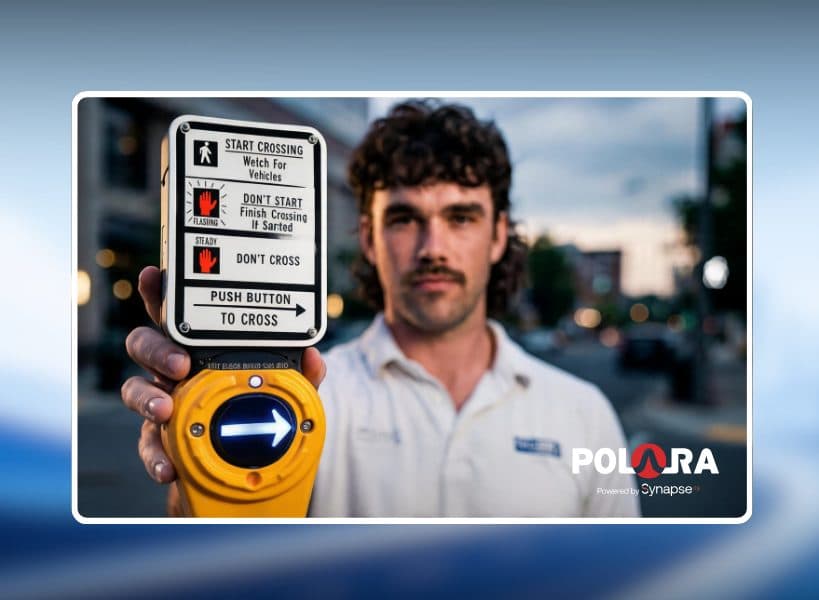
The Polara iDS and iNS bring audible, vibrotactile and touchless "wave to cross" activation to signalized intersections — making the pedestrian phase accessible to more people.
Accessible crossings, without the touch
At a signalized intersection, the WALK symbol only helps if you can see it. The Polara iDS and iNS are Accessible Pedestrian Signal (APS) systems that translate the pedestrian phase into audible, vibrotactile and tactile information — so more people can cross safely and with confidence.
Not just a button
The iNS is the push-button APS station. Beyond placing a crossing call, it adds:
- Audible messages that announce the street name, crossing direction and time remaining
- Vibrotactile feedback and a tactile arrow for pedestrians who rely on touch
- A locator tone — one tone per second — so pedestrians can find the button
- Automatic ambient adjustment: louder in heavy traffic, quieter at night in residential areas
Wave to cross with iDetect
The iDS includes everything in the iNS and adds iDetect, a radar-based touchless sensor. Pedestrians simply wave a hand in front of the button to place a call — no need to press. It's practical in winter gloves, for hygienic no-contact use, or for anyone who finds pressing difficult. Touchless activation supplements the push button; it doesn't replace proper pedestrian signal design.
PedApp: crossing information on the phone
With PedApp, a free pedestrian mobility app, accessibility extends beyond the pole. Pedestrians can locate nearby APS equipment, hear crossing and direction information, and even activate the crossing remotely from a smartphone — helpful for people managing mobility challenges alongside low vision.
Field setup made simple
Configuration is wireless. Using the Polara Field Service App, a technician can set messages, volume and sounds from a phone, a laptop, or the cabinet — then push those settings to every button at the intersection without walking to each pole. Preemption and general-purpose inputs support secondary audio messages for emergency vehicles, railroads and exclusive pedestrian phases.
Flexible deployment: 2-wire and 3-wire
Every intersection is different, so the iDS/iNS deploy two ways:
- 2-wire runs back through the iCCU to the cabinet — ideal for actuated intersections, retrofits on existing button wiring, and setups needing preemption or remote management. Bluetooth models are available where pulling cable isn't practical.
- 3-wire wires directly to the pedestrian head — no iCCU needed — for pre-timed intersections or locations where cabinet wiring is difficult. It delivers every feature except preemption.
Built for real roads
The iDS and iNS are made for public use in every condition — hot, cold or wet. For agencies, that means accessibility, configuration, cabinet flexibility and long-term maintenance in one platform.
See it in action
Watch the full walkthrough with Kyle Miller »
Interested in the iDS or iNS for your intersections? Contact Tacel for technical details or to evaluate a unit.